
Reflections on Friars Quay Part I: Old City, New Attitude

To mark the 50th anniversary of the completion of the Friars Quay housing development in Norwich we asked our Senior Architect Matt Wood to reflect on the project. Here is the first of four short reads.
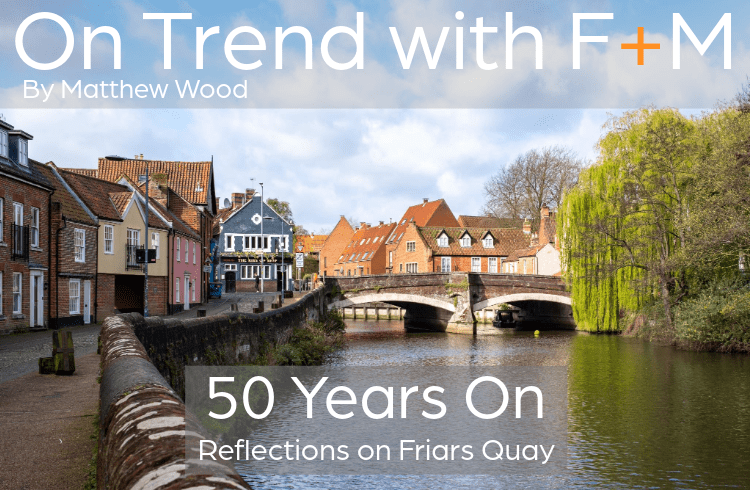
A recent tourism marketing campaign by Visit Norwich called ‘Old City, New Attitude’ features a view along the leafy River Wensum in the heart of the city. On the left bank are Quayside and the Ribs of Beef pub. Beyond Fye Bridge, on the right bank, is the gable of a short terrace of ancient houses backing onto St Clement’s churchyard and The Mischief Tavern, both hidden by the willow trees. In the background, the steeply pitched roofscape of Friars Quay nestles comfortably into the skyline to complete the scene. Friars Quay is a relatively new addition to this view, but it’s older than it looks. On closer inspection you might be forgiven for thinking it dates from the early C21st, inspired perhaps by the forward-thinking Dutch ‘Vinex’ housing programme which influenced so many UK housing-architects during the early 2000s… but this year Friars Quay celebrates its 50th birthday; it was completed in 1975.
The development was the centrepiece of the wider regeneration of Norwich Over the Water – Ultra Aquam – the ancient name for the only portion of the mediaeval walled city that lay on the north bank of the Wensum. In the 1960s the quayside between Colegate and the River Wensum was occupied by two derelict builders’ wharfs which the City purchased in 1970 with a view to redevelopment. Local builder/developer RG Carter was selected as development partner, and Feilden+Mawson were asked to design the project. Since its founding in 1954 F+M had rapidly become the largest practice in Norwich, and its work at Norwich Cathedral and York Minster had brought it a national reputation for working with historic buildings. Combining this with a track record in designing and delivering new buildings – including several at the new University of East Anglia – made it the obvious choice as architect of the Norwich Over the Water project.
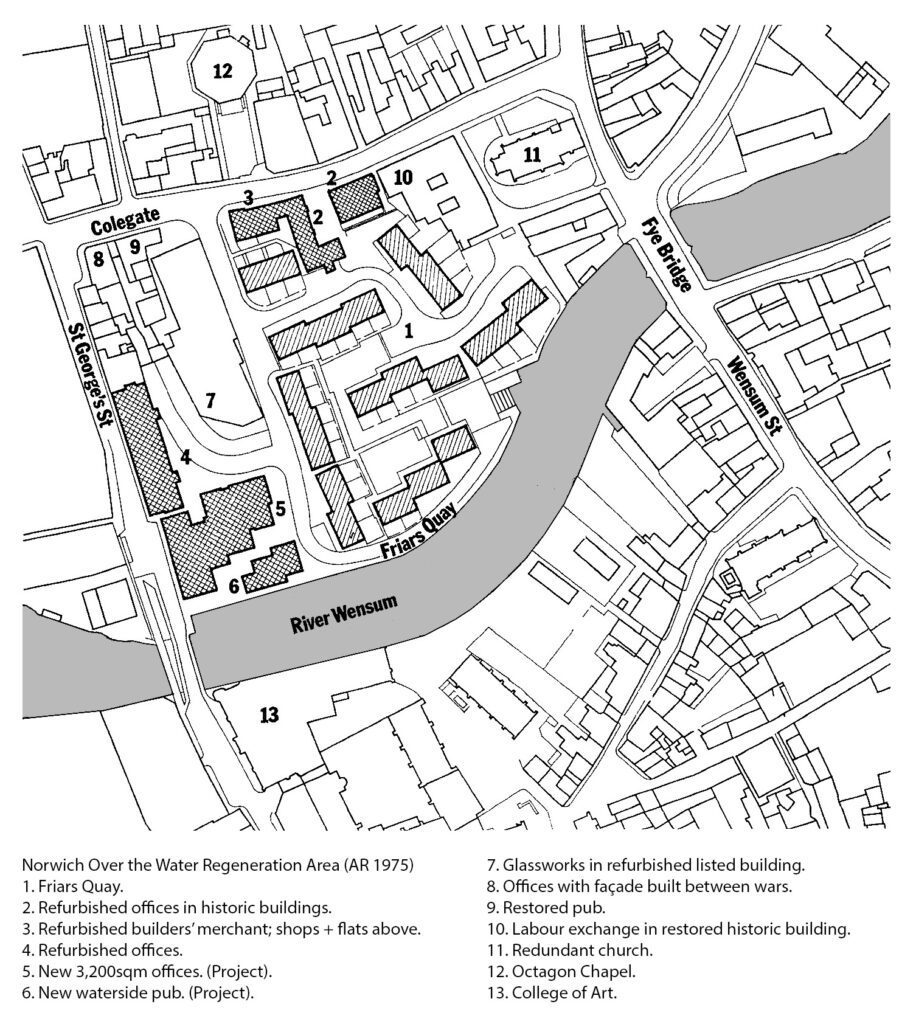
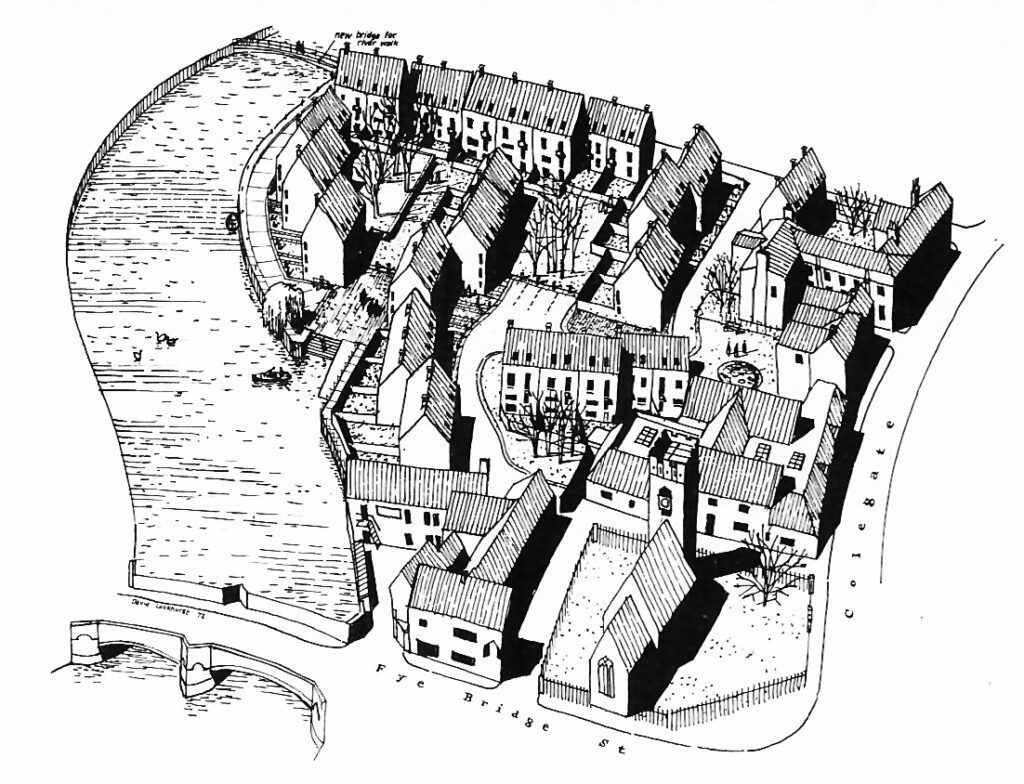
The 40 townhouses which make up Friars Quay are arranged in six short terraces. Two run north-south down the flanks of the site, and the others run roughly east-west, parallel to the river and Colegate. There are three basic house-types, all with the same 6x9m footprint, and each has its main living room at first floor.
Type A is a three-storey house, with the kitchen, dining room and a study at ground floor. Type B is the same, but an integral garage replaces the study. Type C1 is a four-storey house with a full-depth integral garage and study at ground floor, with the kitchen and dining room moved up to first floor with the living room. The Type C2 is the same at first floor and above, but a ‘granny flat’ replaces the garage and study at ground floor. The two dwellings share the main entrance and a small entrance hall, and then have their own inner ‘front door’.

Floor plans Baumeister, 02-1980
The consistent footprint allows the house-types to be mingled together in each terrace, sometimes aligning with each other and sometimes stepping to accommodate the irregular shape of the site. This irregular, ‘organic’ arrangement is emphasised by the use of four subtly different brick colours, apparently randomly, along each terrace. The stepping in plan leads to a corresponding stepping in the roofline, which is probably the project’s most distinctive and successful feature. The roofs are steeply pitched. All house-types have an ‘attic’ storey lit by Velux rooflights, with an actual attic above. Several of these have been converted into additional living space, creating some five-storey houses. Boiler flues and vent-pipes rise vertically and are housed in chimneys which further articulate the skyline.
The development fronts the river to the south and opens up the riverbank with a public walkway connecting St. Georges Bridge in the west, to Fye Bridge in the east. The walkway inflects around a set of wide steps and a slipway down into the river. These are all that remains of the original plan to create an impounded water basin around which the new houses would be arranged. For cost reasons this was eventually omitted, leaving room at the heart of the development for two pedestrianised courtyards now dominated by mature birch trees. To the west of the site is St Georges Green. This was to have been developed as a second phase of Friars Quay, with offices and a new pub on the river, but these plans were eventually shelved for commercial reasons. Its ‘meanwhile use’ as a public open space was eventually made permanent, to the great benefit of what has become a quiet leafy enclave in the heart of the city – including Norwich Playhouse and the various buildings of Norwich University of the Arts.
In 1975 the completed project featured in the November edition of the Architectural Review, which covered ‘European National Heritage Year’, and in Germany’s Baumeister magazine in 1980. Its listing in the second (1990) edition of Pevsner’s ‘The Buildings of England’ could be summarised as ‘nice layout, underwhelming buildings’, and the summing-up is withering: ‘It falls just short of being memorable’. The project stayed in the collective consciousness, however, and in 2001 Friars Quay was included as a case-study in CABE’s ‘Better Places to Live: A Companion Guide to PPG3’, focussing mainly on its layout, density and parking arrangements. To the modern eye, Friars Quay seems to be a project that happened 20 or even 30 years ahead of its time. And viewed with hindsight, in the context of the broad sweep of architectural history, it might be conceded that Friars Quay is an out-lying precursor of what became known as ‘post-Modernism’, rather than an integral and influential part of that emerging movement.
In Part II ‘Pre-Post-Modernism’ we attempt to position Friars Quay in the wider history of late C20th British residential design.
By Matthew Wood, Senior Architect at Feilden+Mawson

