
Reflections on Friar’s Quay Part III: Shared Streets, Squares and Alleys

To mark the 50th anniversary of the completion of the Friars Quay housing development in Norwich we asked our Senior Architect Matt Wood to reflect on the project. Click Here for Part II, or read ahead for Part III.
The 1975 Architectural Review article concludes that Friars Quay ‘is at its best where it frames a vista of some fragment of older building’. Gordon Cullen’s influential 1951 work ‘Townscape’ gave architects and urban designers a renewed awareness of the importance of glimpsed views and serendipity in the experience of walking through cities. Cullen would no doubt have appreciated how the intimate courtyards and alleyways of Friar’s Quay connect into the local street-network, and the project’s layout and streetscape are just as interesting today as the character of its buildings.
Access for vehicles is from a single point on Colegate, so the site is essentially a large cul-de-sac. The road passes down the west side of the site adjacent to St Georges Green, and then sweeps around onto the quayside. A side-road gives access to the northern part of the site, and the arrangement leaves the two courtyards at the heart of the development free of cars. Each house was originally marketed with a single parking space, either on-street or in one of 22 integral garages. Pedestrian routes into and across the site are more numerous than the trafficked roads, and include a number of narrow alleyways connecting directly to St Georges Green, Colegate and Fye Bridge Street.
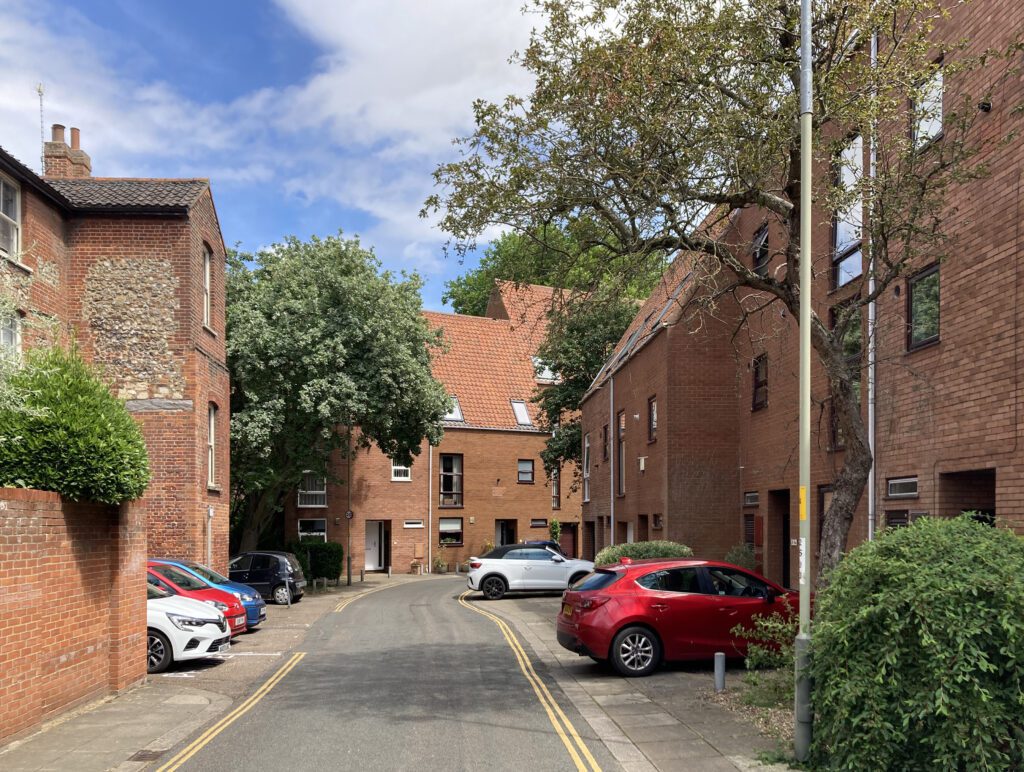
Looking east along northern access road.
There is a current resurgence of interest in ‘Radburn’ planning, where vehicle and pedestrian circulation networks are separated to create a more attractive environment for walking and cycling. The approach was very popular in the 1960s and 1970s, but eventually fell out of favour due to the reduced ‘natural surveillance’ caused by removing cars from some streets. A local constabulary crime-prevention officer assessing Friars Quay today against the ‘Secured by Design’ principles would be concerned about the number of narrow windowless alleys and the rear garden walls facing onto publicly accessible but car-free areas. These are the result of the site layout being optimised, in true Modernist fashion, for solar orientation rather than a more traditional ‘fronts and backs’ approach. The houses are arranged so their living rooms all face south or east, which results in the ‘front’ of one terrace facing the ‘back’ of the next. Residents acknowledge that incidents of anti-social behaviour do occur, particularly on weekend nights, but not as much as one might reasonably expect. The first floor living rooms with their prominent balconies probably help in this regard, giving good natural surveillance across the non-trafficked areas. The first floor living spaces also give each home a pleasant and very immediate outlook over the river or courtyards.
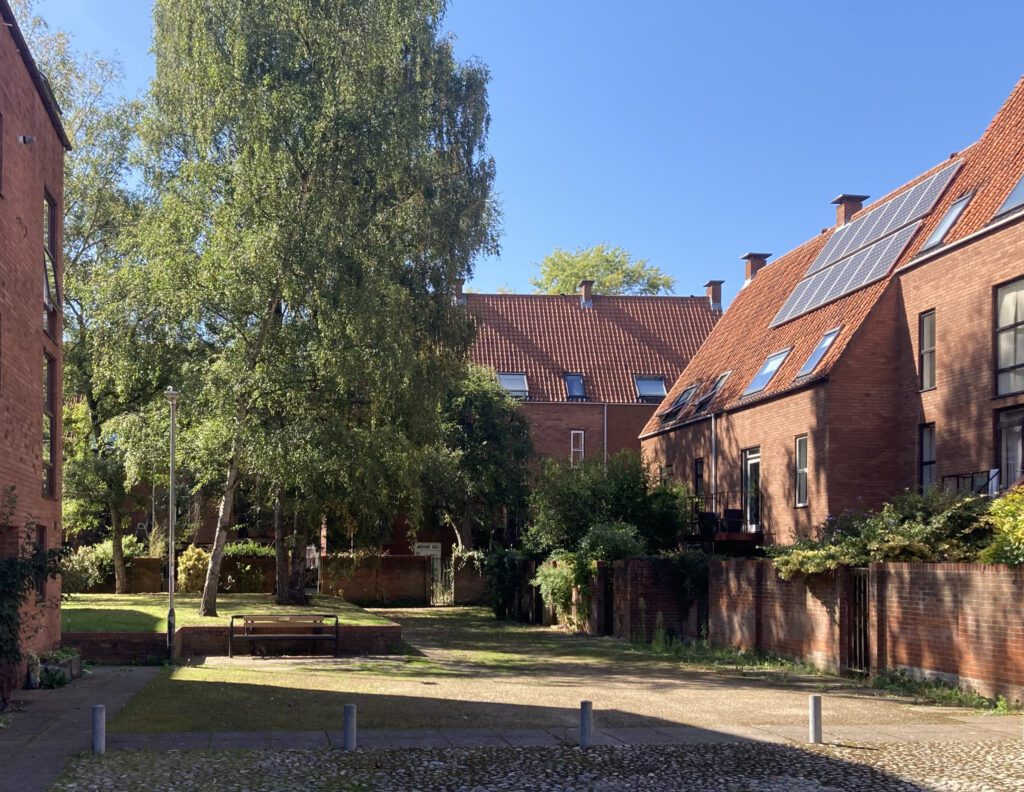
Landscaping is very simple and has proved robust: fully mature birch trees now stand in the raised lawns, edged with low brick walls, and Breedon gravel covers the remainder of each courtyard. Footpaths through these areas are picked out in simple paving slab ‘stepping stones’ and the quayside roadway and footpath are finished in exposed-aggregate mass concrete. The vehicle-trafficked roads and footpaths are adopted, and the remaining landscaping is maintained by the City Council, who was the original developer. A management company was never set up, and this has proved a mixed blessing to the residents. The site is maintained at the city’s expense, without a service-charge to the residents, but this means they have no control over the level or type of maintenance carried out. Replacement of the original frosted-globe street-lamps with the city’s standard, rather harsh LED streetlighting was not popular with residents, but they had no way of resisting it. And as the birch trees reach the end of their life, issues of safety and future replacement begin to loom. For the time being, however, the extent and quality of the public realm remains one of the features of Friars Quay its residents find most enjoyable.
Click here to read the final instalment Friars Quay Part IV, ‘An (Un)Intentional Community’, sharing thoughts from residents and concluding remarks on the legacy of Friars Quay.
By Matthew Wood, Senior Architect at Feilden+Mawson
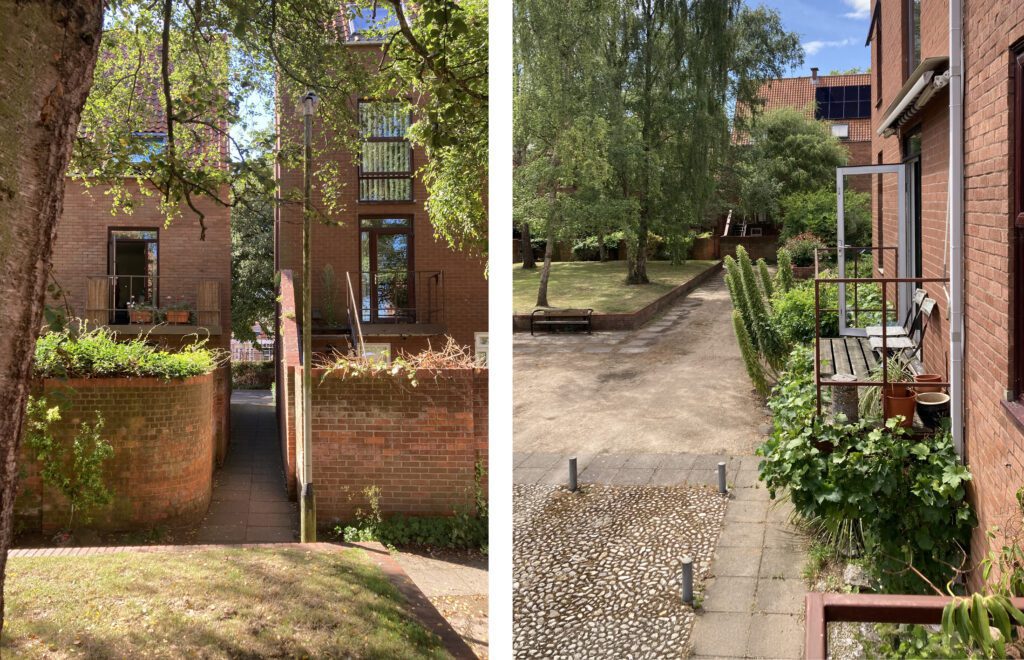
(Left) Pedestrian alley connecting west to St Georges Green. (Right) View from first floor living room balcony.