
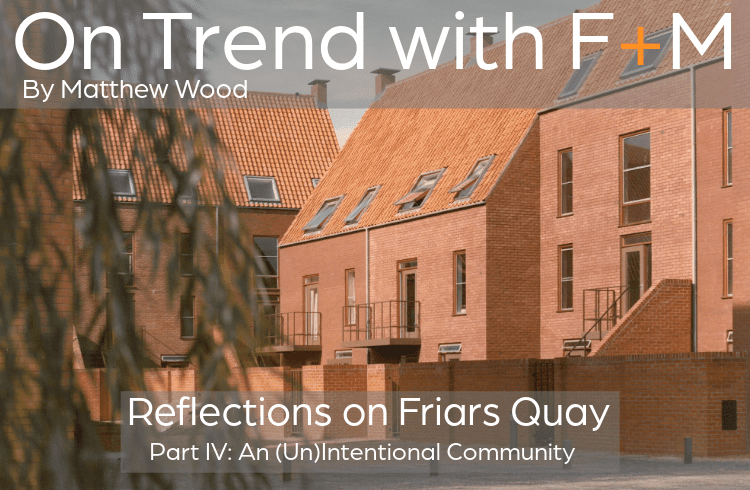
Reflections on Friars Quay Part IV: An (Un)Intentional Community

To mark the 50th anniversary of the completion of the Friars Quay housing development in Norwich we asked our Senior Architect Matt Wood to reflect on the project. Click Here for Part III, or read ahead for Part IV.
The redevelopment of Norwich Over the Water was an early example of residential-led urban regeneration which took place 20 years before it became common in London, Manchester and a number of other northern cities. The Architectural Review wondered whether it would actually work:
‘Though time is probably playing into the hands of those who wish to draw the middle class out of their spacious old rectories in surrounding villages, it is doubtful whether at this moment they can be drawn in by the prospect of living in what is, after all, only a sympathetic and slightly upped version of the public authority housing estate… Will they find that the convenience (easy cleaning) of small rooms out-tops the luxury of large ones? Will they accept again a community ‘image’ in place of the individual image they have grown used to in seclusion?’
The answer, it turns out, was a resounding ‘yes’. Despite the nervousness of local estate agents about the novel concept of city-centre living, Friars Quay has proved immensely popular with the people who live there. The residents’ association is very active, drawing on a real shared affection the inhabitants have both for the development as a whole, and for their homes within it. This account from one resident is typical:
‘The fact that the houses are all ‘around’ each other helps us to ‘mingle’. The car parking and front drives mean you bump into each other to chat. It’s easy to have a BBQ in the centre. The house interior design is comfortable, and the stairs keep us fit.’

Friars Quay Residents’ Association 50th Anniversary exhibition.
Feilden+Mawson project architect David Luckhurst claims that he didn’t make any conscious design decisions with community-building in mind, but he has enjoyed keeping in touch with the residents over the years at their regular BBQs and other celebrations. Like many residents we spoke to, he thinks the fact that the scheme appeals to a particular type of purchaser is as important as its physical qualities in building a sense of belonging. Most residents are comparatively older, having moved to Friars Quay as a down-sizing strategy (leaving their ‘spacious old rectories’, perhaps!) or simply having lived here a long time. A number of the original purchasers were returning ex-pats, attracted by the instant community that such an unusual development created. There have been families with children over the years, but a recent new-born is the first in a long time – and a great pleasure to all. Most residents agree the relatively limited outdoor space is probably a barrier in this regard, and most of the houses are now under-occupied.
Conclusion
Friars Quay was the product of a number of fortunate events: a city on the rise with strong leadership and a vision of its future, an architectural practice at the height of its powers and reputation, and an imaginative and confident project architect with a fresh perspective on the design challenge presented to him. Despite, or maybe because of its age, it still has much to teach us. We will give the last words to Ian Nairn who wrote for the Sunday Times in 1975 (almost as a rebuke to the mean-spirited coverage in the Architectural Review):
‘Friars Quay, Norwich: making a better place than it was before… Norwich fashion has now produced Friars Quay, and it is probably Britain’s best contribution to Heritage Year. Romantic it is – and why not? We are badly in need of some romance at the moment. Sensitively placed, too, with no false Cartesian logic; if a projection or angle will help the sense of place then it is provided… And the moral for the rest of the country is: first, that the city planners both understood the problem and were sympathetic to solving it; and second, that they were lucky enough to have the cooperation of a local firm of architects who could come up with an equally sympathetic answer.’
By Matthew Wood, Senior Architect at Feilden+Mawson. November 2025.

Acknowledgements
Thanks to the Friars Quay Residents’ Association for continuing to enthuse about Friars Quay and involving us in the anniversary celebrations.
Thanks to David Luckhurst for giving his time to show us round Friars Quay this summer and for sharing his recollections of designing the project.
Thanks to Alan Powers of the C20th Society for reviewing a draft of these articles and giving some useful feedback.